2010'dan 2026'ya, 16. Yıl

Hamilelikte Kıyafet Seçimi: Rahatlık ve Stilin 10 Altın Kuralı 🤰✨

Hamilelikte elbise kalıpları gebeliğin ilerleyen döneminde değişmektedir. 

Hamilelik, bedeninizin ve ruhunuzun dönüşüm geçirdiği mucizevi bir süreç. Bu dönemde kıyafet seçimi, hem konfor hem de özgüven için kritik! İşte hamilelikte kıyafet alışverişi yaparken dikkat etmeniz gerekenler ve pratik ipuçları:


1. Hamilelikte Bedeniniz Nasıl Değişir? 🌸

  • Karın & Göğüs: Rahmin genişlemesiyle karın büyür; göğüsler hormonlar nedeniyle hassaslaşır ve 1-2 beden büyüyebilir.
  • Kalça & Bacaklar: Kilo artışı ve ödem, kalça ve uyluklarda hacim değişikliğine yol açar.
  • Cilt Hassasiyeti: Sentetik kumaşlar kaşıntı ve tahrişe neden olabilir.

📌 Not: Bu değişimler geçici! Kendinizi kısıtlamayan, nefes alan kıyafetlerle rahat hissetmek önceliğiniz olsun.


2. Hamile Kıyafeti Seçerken Nelere Dikkat Edilmeli?

🔹 Konforu Önceleyin

  • Kumaş: %100 pamuk, bambu, jersey veya elastan karışımlı esnek kumaşlar tercih edin.
  • Bel Tasarımı: Geniş, yumuşak bel bantlı pantolonlar veya ayarlanabilir belli elbiseler idealdir.
  • Kan Dolaşımını Engelleyen Detaylar: Sıkı lastikler, dar kemerler ve baskılı bel bölgelerinden kaçının.

🔹 Pratiklik & İşlevsellik

  • Emzirmeye Uyumlu: Önden düğmeli bluzlar veya gizli emzirme açıklığı olan kıyafetlerle uzun vadeli kullanım sağlayın.
  • Katmanlı Giyim: Hamilelikte ani sıcak basmaları için ince katmanlar halinde giyinin (ör: pamuklu içlik + hırka).

🔹 Stilinizi Yansıtan Detaylar

  • Renk & Desen: Dikey çizgiler, küçük desenler ve pastel tonlar hacim algısını azaltır.
  • Aksesuarlarla Kişiselleştirin: Uzun kolyeler, renkli şallar veya şapkalarla kombinleri tamamlayın.

3. İç Çamaşırı Seçimi: En Önemli Adım! 👙

  • Sütyen:
    • Penye & Telsiz: Meme hassasiyeti için yumuşak, balensiz modeller seçin.
    • Ayarlanabilir Askılar: Göğüs ölçünüz değiştikçe genişletilebilen askılar kullanın.
  • Külot:
    • Yüksek Belli & Pamuklu: Karın bölgesini sıkmadan destekleyen modelleri tercih edin.
    • Doğum Sonrası İçin: Emici postpartum külotlarını araştırın.

4. Tesettür Giyimde Hamile Modası 🧕

  • Uzun Tunikler & Abiyeler: Esnek kumaşlı, beli belli etmeyen tasarımlarla hem şık hem rahat olun.
  • Şalvar & Bol Paça Pantolonlar: Karın bölgesini sıkmayan hafif kumaşlarla kombin yapın.
  • Hafif Şallar: Nefes alan pamuklu veya ipek şallarla sıcaklamadan stil yaratın.
Tesettür giyimde de hamile giysileri çok çeşitli model ve şekilde sunulmaktadır.

5. Ekonomik & Çevre Dostu Çözümler 🌿

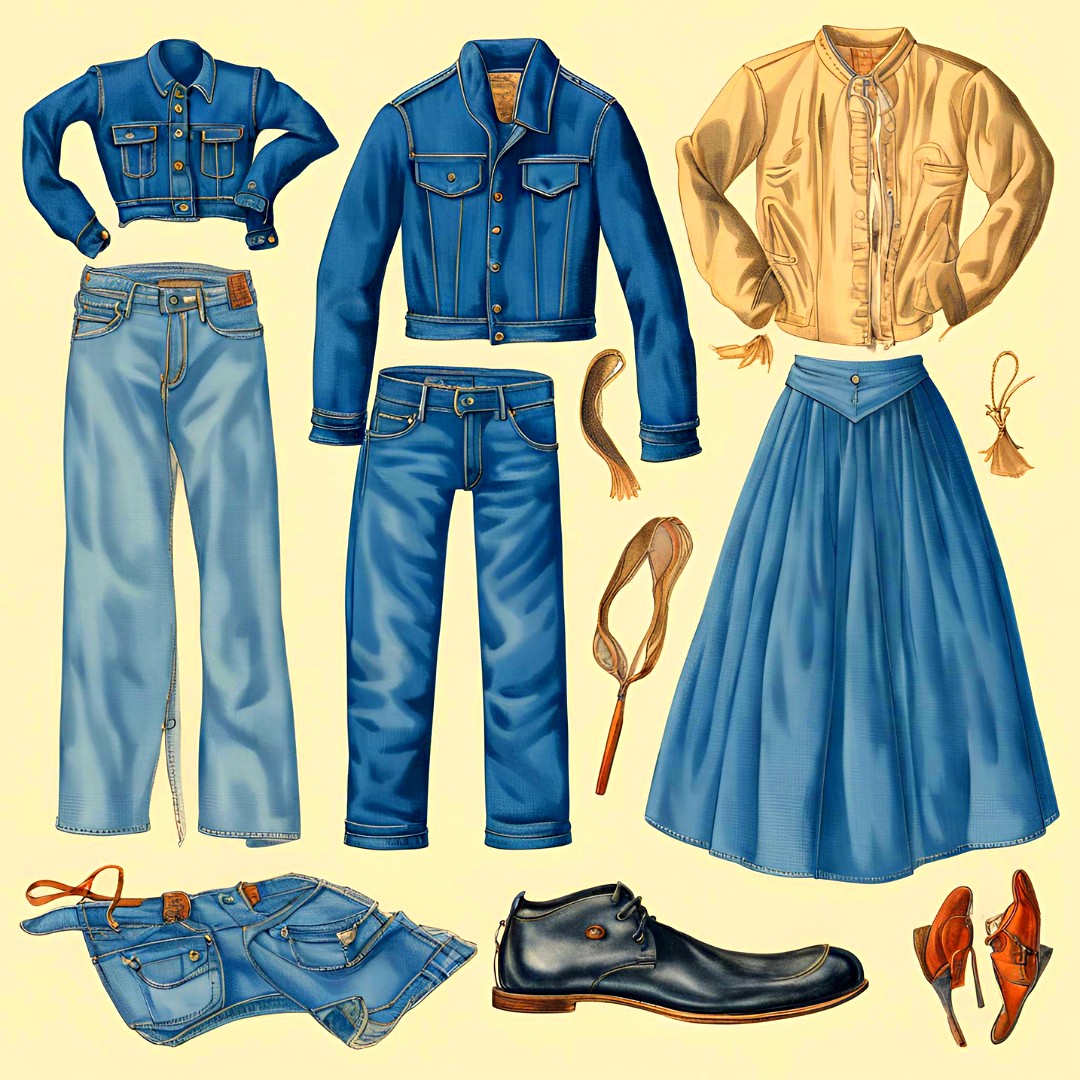
  • Normal Kıyafetleri Dönüştürün: Bol üstler + esnek eteklerle hamile gardırobunuzu genişletin.

6. Hamilelikte Kaçınılması Gerekenler! ⚠️

  • Sıkı Korseler & Kemerler: Kan dolaşımını engeller, ödemi artırır.
  • Topuklu Ayakkabılar: Denge kaybı ve bel ağrısı riski nedeniyle düz veya alçak topuklu ayakkabılar tercih edin.
  • Sentetik Kumaşlar: Terlemeyi artırır, mantar enfeksiyonu riskini yükseltir.

7. Gebelikte Yaz Kıyafetleri ☀️

  • Hafif Kumaşlar: Yazın, ince ve nefes alabilen kumaşlar (pamuk, bambu) tercih edin.
  • Sıcak Havalar İçin Giyim: Tunikler, elbiseler ve kısa şortlar gibi rahat parçalarla sıcaklarda ferah kalın.

8. Kışın Hamile Giyimi ❄️

  • Katmanlı Giyim: Soğuk havalarda, rahat bir kazak ve uzun kaban ile katmanlı giyim tercih edin.
  • Termal İçlikler: Soğuk günlerde vücut ısısını koruyan termal içlikler kullanın.

9. Hamilelikte Ayakkabı Seçimi 👟

  • Rahat ve Destekleyici: Düz ve rahat ayakkabılar tercih edin. Hafif, destekli tabanlar bacak ve bel ağrısını engelleyebilir.
  • Şişen Ayaklar İçin Şişme Ayakkabılar: Ayaklarınızda şişlik oluşuyorsa, ayarlanabilir bağcıklar veya genişletilebilir ayakkabılar tercih edin.

10. Hamilelikte Vücut Değişimlerine Göre Kıyafet Seçimi 👗

  • Vücut Tipine Göre Seçimler: Hamilelik boyunca vücut şekli değişebilir. Bu dönemde, vücut tipinize uygun kıyafetler seçmek rahatlık açısından önemlidir. Örneğin, genişleyen kalçalara sahip biri rahat etek ve pantolonları tercih edebilirken, genişleyen göğüsler için uygun bir sütyen ve elbise tercihi yapabilirsiniz.
  • Vücut Hatlarını Öne Çıkarma: Hamileliğinizin her döneminde vücut hatlarınızı nazikçe vurgulayan elbiseler, kendinizi şık hissetmenizi sağlayabilir. Aşağıya doğru genişleyen kesimler veya kuşaklı elbiseler kullanarak rahat ve şık bir görünüm elde edebilirsiniz.

Hamilelik Gardırop Checklist’i ✅

  1. Kumaş: %90 pamuk/elastan karışımı mı?
  2. Bel/Karın: Sıkıyor mu? Esnek mi?
  3. Emzirme Uyumu: İleride de kullanılabilir mi?
  4. Yıkama Talimatı: Çekme yapar mı?
  5. Mevsim: Hava şartlarına uygun mu?

Unutmayın: Hamilelik, tarzınızdan ödün vermeniz gereken bir dönem değil! 🎀 Doğru seçimlerle hem kendinizi hem bebeğinizi mutlu edin. Bu rehber, hamilelikte konfor ve şıklığı bir arada sunarken pratik çözümlerle annelik yolculuğunuza ışık tutacak! 💖

Kimyasal Lif Nedir, Kimyasal Liflerin Tarihi ve Gelişim Süreci

Kimyasal lifler. 
Kimyasal lif (Alm. Chemiefaser, Fr. fibre chimique, İng. chemical fiber; man-made fiber), kaynağı doğal ya da sentezlenmiş polimer olan, fabrikalarda özel tekniklerle üretilen liflere denir. 

Kimyasal Lif Tarihçesi 
İnsanlığın, beslenme, barınma gibi üç temel ihtiyacından biri olan örtünme gereksinimi 20. yüzyılın ortalarına kadar doğal liflerle karşılanmış; ancak doğal liflerin elde edilmesinde yaşanan bazı zorluklar, maliyet, iyileştirme ihtiyacı, daha üstün niteliklerde ürün elde etme isteği, moda, doğal liflerin ihtiyacı karşılayamaması gibi nedenlerden dolayı, tekstil bilimi devamlı doğal liflerin yerini alabilecek yeni tür liflerin arayışı içinde olmuştur. 

İngiliz Robert Hooke 1665 yılında ipeğin taklit edilebileceğini öne sürmüş; 1842’de yine İngiliz Lois Schawebe cam üzerinde filament elde etmiştir. 1846’da selüloz, nitrik asitle muamele edilmiş ve çözülmüştür. 1884’de Fransız Count Chardonnet selülozu çözerek asırlardır süren suni ipek rüyasını gerçekleştirmiştir. Yine Fransız Despeissis selülozu bakırda çözmüştür. İlk defa 1897’de İngiliz Steam viskoz yöntemini bulmuş; 1903’te Amerikalı Miles selüloz asetatı bulmuştur. 

1925 yılında Alman kimyager Prof. Hermann Staudinger’in makromoleküller üzerine yapmış olduğu çalışmalarla doğal liflerin uzun moleküler zincir yapılarına sahip olduklarını ispatlayarak modern kimyasal lif biliminin temelini oluşturmuştur. 1931 yılında ise Amerikalı araştırmacı Carother hexametilen glikol adipatin (poly) 80 santigrat derecede erimesi ile çeşitli lineer polyester lif oluşumunu açıklamış, ancak bunda çok başarılı olamayarak çalışmalarını polyamid üzerinde yoğunlaştırmıştır. Kimyager bir gün bir deney tüpünü doldurduktan sonra üzerine iğnenin ucuyla delik açmasıyla ve buradan havaya eriyik püskürmesiyle, havada soğuyarak akan bu eriyiğin filament haline geldiğini görmüştür. Bunun sonucunda 1935 şubatında hexametilen diamin ve adipik asit ile ilk polyamid olan naylon 6.6’yı keşfetmiştir. 

Amerika’da DuPont, İtalya’da Snia Viskosa ve Almanya’da Glanzstoff bu patentlere sahip olarak doğrudan üretim metodu ile fabrikalar kurmuşlardır. 1938’de Amerika’da Carothen yönetiminde bir grup Amerikalı bilim adamının eğrilebilir polyamidi sentetik olarak üretebilmeleri naylon 66’nın (perlon) doğumu olmuştur. 1939’da Alman araştırmacı P. Schlack naylon 6’yı bulmuştur. İngiliz araştırmacılar Whinfield ve Dickson 1941’de Manchester’da tereftalif asit ve glikolden ilk defa polyester liflerinin (terylene, dacron, diolen, terlenka, trevira) üretimini gerçekleştirmiştir. 

Alman araştırmacı H. Rein 1942 yılında dimetilformamidi bulmuş ve polyakril lifleri (dralon, orlon) üreterek bugüne kadar ki sentetik lif ve ipliklerin en önemlilerinin buluşları tamamlanmıştır. 1954 yılında ise İtalyan Natta polipropileni bulmuştur. Bu gelişmelerin sonucunda kimyasal lifler ortaya çıkmıştır. Böylece ''doğal lif''lerin dışında kalan tekstil lifleri kimyasal lifler başlığı altında 2 ana grup olarak sınıflandırılmıştır: 
1. Rejenere - Doğal Polimer - Yapay Lifler (Suni Lifler, Man-made Fibers), 
2. Sentetik Lifler. 

İlk olarak suni lifler keşfedilmiş; uzun bir aradan sonra sentetik lifler bulunmuştur. Doğal lifler doğadaki adlarıyla anılırken; suni lifler üretim yöntemleri, sentetik lifler ise elde edildikleri monomerinin başına poli kelimesi gelmesi ile anılırlar. 

Yarn Types and Usage Places

The primary classification of yarns is as filament and staple: 
Yarns types. 
Filament Yarns: 
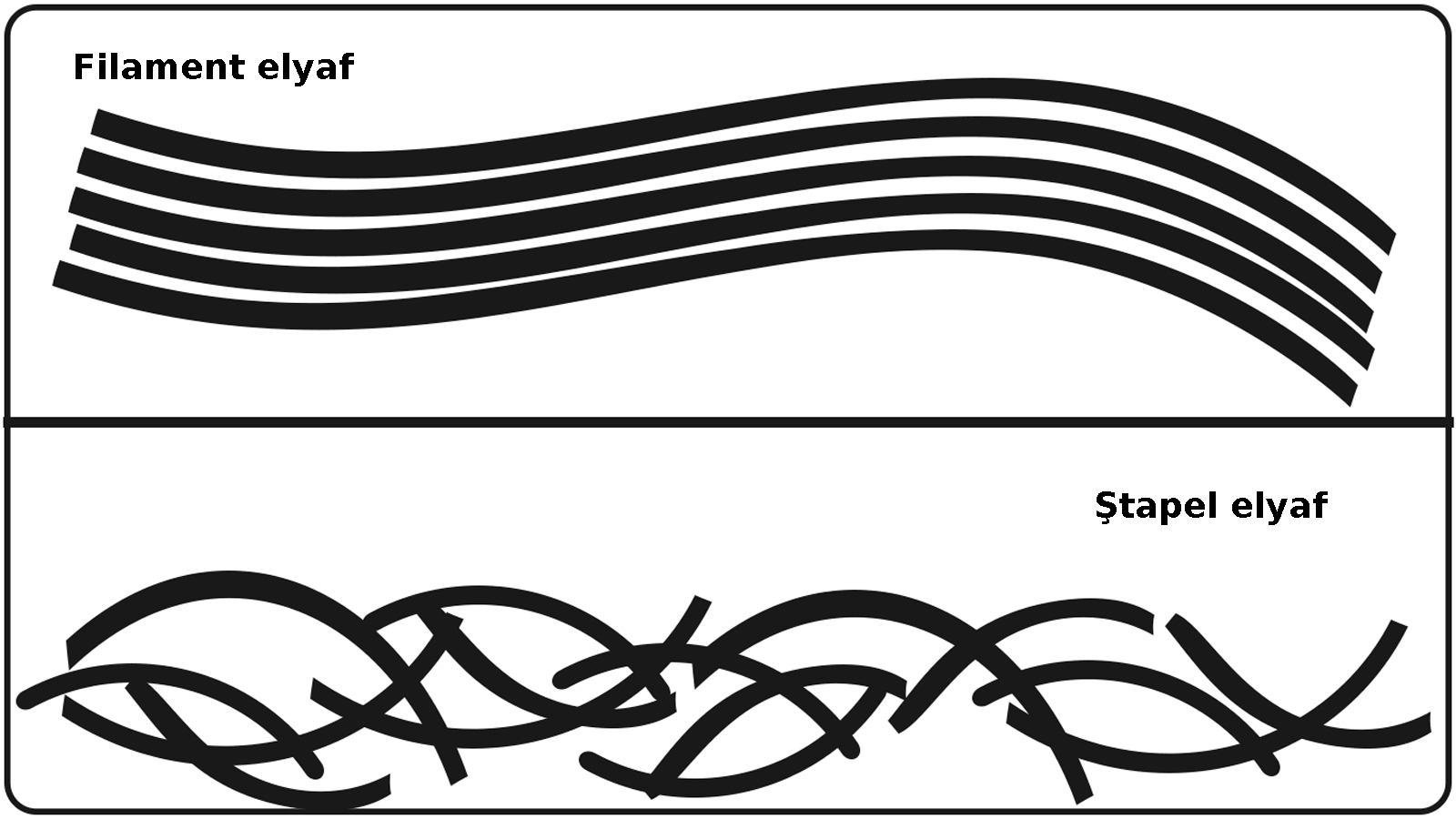
Filament yarns are made from long, continuous strands of fiber. Monofilament yarns, those made from a single filament, find limited use in nylon hosiery (where an exceptionally sheer fabric is wanted), in some open-work decorative fabrics, and in fabric webbing (used in some lightweight beach or casual furniture) as well as in a variety of industrial uses. More commonly, many filaments are joined to form multifilament yarns. Multi-filament yarns can be made more cohesive by twisting them together loosely or more tightly. The amount of twist together with the characteristics of the fibers (luster, hand, cross-sectional shape, etc.) will determine the appearance and feel of the yarn. For example, a loosely twisted smooth filament yarn made from a bright fiber would be characterized by marked luster, resistance to pilling, and a smooth surface. Sometimes filament yarns are put through an additional process called texturing. Texturing modifies the feel and bulk of filament yarns. 

Staple Yarns: 
Staple, or spun, yarns are made from staple length fibers. Being short, staple fibers must be held together by some means in order to be formed into a long, continuous yarn. Although the multiple processes required to make staple yarn add significantly to the cost of the yarn, the aesthetic qualities such as comfort, warmth, softness, and appearance make these yarns highly desirable in many products. Natural fibers, except for silk, are all staple fibers. Silk and manufactured fibers can be cut or broken into staple fibers, so that it is possible to spin any natural or manufactured fiber into a staple yarn. In addition to identifying yarns as being made from either filament or staple fibers, yarns are also classified based on a number of other characteristics. Authorities often differ when they define yarn types. The following are the most common classifications. 

Yarns Classified by Number Of Parts 
Yarns that have been classified by the number of parts they possess are divided into single, ply, and cord yarns. 

A single yarn is made from a group of filament or staple fibers twisted together. If a single yarn is untwisted, it will separate into fibers. A single yarn might be identified as either a single yarn of staple fibers or a single yarn of filament fibers. 

Ply yarns are made by twisting together two or more single yarns. If ply yarns are untwisted, they will divide into two or more single yarns, which, in turn, can be untwisted into fibers. Each single yarn twisted into a ply yarn is called a ply. 

Cord yarns are made by twisting together two or more ply yarns. Cord yarns can be identified by untwisting the yarn to form two or more ply yarns. Cord yarns are used in making ropes, sewing thread, and cordage and are woven as decorative yarns into some heavyweight novelty fabrics. 

Yarns Classified By Similarity Of Parts 
Simple yarns are those yarns with uniform size and regular surface. They have varying degrees of twist, ranging from loose to moderate, tight or hard twist. Single, ply and cord yarns can all be simple yarns if their components are uniform in size and have a regular surface. When one strand of fibers is twisted together evenly, it is classified as a simple single yarn. Two simple, single yarns twisted together create a simple ply yarn. Yarns made to create interesting decorative effects in the fabrics into which they are woven are known as novelty yarns. Some authors also call these yarns complex yarns, although complex yarns usually have more than one part. Novelty yarns can be single, ply, or cord, staple or filament. Novelty yarns are used in knitted sweaters and dresses, contemporary drapery and upholstery fabrics, and the decoration of men’s and women’s suiting fabrics. In the industry novelty yarns tend to be referred to as fancy yarns. Terminology identifying these yarns is confusing. The following list of terms and their definitions represents an attempt to define these terms as they appear to be accepted by most authorities. 
Yarn Types 
- Boucle yarns are ply yarns. An effect yarn (so-called because it is used to create decorative effects) forms irregular loops around a base yarn or yarns. Another yarn binds or ties the effect yarn to the base. Ratine yarns are similar to boucle in construction. The loops in ratine yarns are spaced evenly along the base yarn. Snarl yarns are another type of loop yarn in which two or more single yarns under different tension are twisted together. The varying tension allows the effect yarn to form alternating unclosed loops on either side of the base yarn. 

- Flake, flock, or seed yarns are made of loosely twisted yarns that are held in place either by a base yarn as it twists or by a third or binder yarn. These yarns are relatively weak and are used in the filling to achieve decorative surface effects. 

- Nub yarns are ply yarns in which an effect yarn is twisted around a base yarn a number of times in a small area to cause an enlarged bump or "nub.' Sometimes a binder yarn is used to hold the nubs in place. The spacing of the nubs may be at regular or irregular intervals. Nubs are often different colors than the base yarn. The terms knot, spot, or knop are also applied to this type of yarn. 

- Slub yarns may be either ply or single yarns of staple fibers. The slub effect is created by varying the twist in the yarn, allowing areas of looser twist to be created. This produces a long, thick, soft area in the fabric called a slub. Slub yarns are irregular in diameter. The surface of fabrics woven with slub yarns shows these irregularities. Yarns made in this way have areas of varying twist, causing weaker areas in the yarn. In many fabrics slub yarns are placed in the filling or crosswise direction where fabrics receive less strain. Slubs are the same color as the rest of the yarn and cannot be pulled out of the fabric without damaging the structure of the fabric. Filament yarns can be spun with varying degrees of twist. These yarns also create a slubbed appearance in fabrics. Such filament yarns are known as thick-and-thin yarns. 

- Spiral or corkscrew yarns are made of two plies, one soft and heavy, the other fine. The heavy yarn winds around the fine yarn. 

- Chenille yarns are made by a totally different process and require several steps in their preparation. First, leno-weave fabric is woven. This fabric is cut into strips, and these strips, which have a soft pile on all sides, are used as yarns. 

Man-Made Systems

Man-made fibers are produced from polymers. Man-made fibers are manufactured by spinning the polymer. There are three major types of spinning processes: melt, dry and wet spinning. 

Melt spinning 
In melt spinning, the polymer is melted by heating. The molten polymer is pumped through the tiny holes of a spinnerette; thus the fiber is formed. The fiber is then cooled and solidified. 
Simple fibre extrusion 
Dry spinning 
In dry spinning, polymer is dissolved in a solvent. After extrusion through a spinnerette, the solvent is evaporated and the fiber is solidified.  
Dry spinning 
Wet spinning 
In wet spinning, the polymer is dissolved in a solvent similar to dry spinning. After extrusion, the solvent is removed in a liquid coagulating medium. 
Wet spinning 

Woolen System

This is a versatile system for fibers with a mean fiber length of 25-80 mm, producing bulky, whiskery yarns from wool, waste fibers, reprocessed fibers, fibers of various colours, man-made fibers, and their blends. In this system, the carded web is converted to a number of slubbings rather than a single sliver. The slubbings are directly converted to yarn, and the fibers are therefore not aligned. This system may be used to produce hand-knitting yarns, carpet yarns, and yarns for the manufacture of apparel items such as certain types of women's dresswear and men's jackets. The weave pattern of fabrics made from such yarns is generally not as well defined as that in fabrics made from worsted-system yarns because of the arrangement of fibers in the yarn, the fullness of the yarn, and the effect of subsequent finishing treatments. 
The woollen system 
The Worsted System 
The worsted system, for fibers with a mean fiber length of 40-200 mm, consists of the two specialist operations of topmaking, where combed slivers are produced, and spinning, where the sliver is converted to a yarn. Mills may be topmakers, spinners, or vertical organisations, which carry out both the operations. Combing is an essential stage in the worsted system. The system produces lean yarns with comparatively well-defined twist from well-ordered fibers of wool, man-made staple fibers, and their blends. Yarns produced by this system are used in the manufacture of high-quality apparel fabrics, such as suitings. 
Worsted system 
The Semi-worsted System 
There is no combing stage in this system for fibers with a mean fiber length of 75-150 mm, which handles long wools, man-made staple fibers, and their blends. This system is widely used to produce coarse yarns required for the manufacture of carpets and upholstery fabrics. The system is also used to produce hand-knitting yarns. 
Semi-worsted system 

Cotton Yarn Manufacture Systems

This is the most widely used system for fibers with a mean fiber length of 15-50 mm and can process cotton, man-made staple fiber, and their blends. Yarns can be either carded or combed. Combed yarns are produced when the fibers are subjected to the combing operation, which is an option with this system. 
The cotton system 
The cotton system

Systems Of Yarn Manufacture

Although there are important differences, the process stages and the machines used at each stage in processing wool and cotton have similar underlying principles. Taking into consideration the necessity to cater for a continuous process, these are:
-Cleaning, blending, and completely disentangling the fibers;
-Assembly of the opened fibers into a continuous length;
-Reducing the number of fibers in the cross-section to form a strand of the required linear density or count, twisting of the strand to form a yarn, and winding the yarn onto a package.

In modern yarn manufacture, these stages may be said to translate to the following stages:
-Preparation for carding;
-Carding;
-Preparation for spinning: 
-Spinning.

Carding is a process that completely disentangles the fibers, ideally separating them to the single-fiber level. It is at this stage that the web of fibers is formed into a continuous sliver.

A schematic of the cotton card
A typical woolen card consists of two sections, the scribbler and the carder, each consisting of a number of cylinders. 
The woolen card
Man-made fibers are produced in continuous lengths by an extrusion process. Before these extruded fibers can enter the standard yarn-production process, they need to be chopped or stretch-broken into short lengths of fiber. The average length can be chosen depending on the system of yarn manufacture used for processing the particular man-made fiber. Man-made fibers usually enter the processing chain either at the preparation-for-carding stage or at the preparation-for-spinning stage. In some systems of yarn manufacture, when processing cotton and wool, there is an additional stage of combing, after carding, where a proportion of the shortest fibers and any remaining impurities are removed. Combing produces a higher-quality and more lustrous yarn. 

Although the processing steps in converting fiber to yarn generally follow these stages, different methods and machine designs are required to handle the different fiber types. Furthermore, it is also possible to manipulate fibers in different ways to produce yarns with completely different characteristics. Different systems of yarn manufacture have therefore evolved. The primary systems of yarn manufacture are; 

Man-made Fibers

Man-made fibers scheme 
Man-made Fibers are two types: Organic and Inorganic Fibers

Organic Fibers 
These are the fibers that are not found in natural. They are all produced by human from regenerated cellulose and petroleum derivatives. A general description of broad bases for classification of manufactured fibers should be helpful. 

Fibers Derived from a Cellulosic Base 
Some fibers, such as rayon and acetate, have a base of natural plant cellulose, the same as cotton. Other fibers are based on protein found in milk, soybeans, or corn meal. Others are based on natural rubber from the rubber tree. 

Fibers Derived Synthetically from a Noncellulosic Base 
Nylon, Polyester, Acrylic, Modacrylic etc. The fibers in this classification may be called general-purpose fibers since they are widely used for many kinds of clothing and for many industrial purposes. The fiber-forming substances are chemical compounds created largely from petroleum and natural gas. These compounds are also used for plastic materials. Other noncellulosic man-made synthetic fibers may be called special-purpose fibers. 

Inorganic man-made fibres 
They are glass, metallic, rock wool, carbon, ceramic etc. 

İplik Numarasının Bulunması

Tekstil iplik numaralandırma sistemleri uzunluk ve ağırlık olmak üzere iki sisteme ayrılır. 
İplik Numaralandırma Sistemleri 
İpliğin (bükümlü ipliğin) inceliği belirli bir sayı ile gösterilmektedir. Bu incelik değerine numaralandırma denir. Numaralar belirli numara sistemlerine göre düzenlenmişlerdir. 

Uzunluğuna Göre İplik Numaralandırma Sistemleri 
Metrik Numaralandırma Sistemi (Nm) 1 gram olan tek kat ipliğin metre olarak uzunluğu ipliğin ''Nm'' cinsinden değerini gösterir. İpek, sentetik ve katlı bükülmüş dikiş iplikleri için kullanılır. 
FORMÜL: Nm = Uzunluk (metre)÷Ağırlık (gram), 
Örnek: 22 metre uzunluğunda 1 gram ağırlığındaki ipliğin Nm cinsinden değerini bulalım. 
Nm =22/1 (metre/gram) = 22 
Sonuç: 22 Nm'dir. 

İngiliz Numaralandırma Sistemi (Ne) 
İngiliz pamuk numarası 1 Libre ağırlığa sahip olan 1 Hank olarak uzunluk sayısıdır. Pamuk ve ketenden oluşan ipliklerde daha çok kullanılır. 
FORMÜL: Ne =Uzunluk (hank) ÷ Ağırlık (libre), 
Uzunluk birimi:1 hank= 840 yarda= 768 metre, 
Ağırlık birimi: 1 libre= 16 ons= 454 gram, 
Örnek: 20 Ne; 20 hank uzunluğunda 1 libre ağırlığındaki ipliğin İngiliz değerini bulalım. 
Ne =20/1 hank/libre = 20 
Sonuç: 20 Ne'dir. 

Uzunluğuna göre belirlenen numaralandırma sistemlerinde iplik inceldikçe numara büyür. 

Ağırlığına Göre İplik Numaralandırma Sistemleri 
Tex Numaralandırma Sistemleri: 1000 metre ipliğin gram olarak ağırlığı ipliğin tex değerini verir. Sentetik filament (kesiksiz elyaf) iplikler için kullanılır. 
FORMÜL: Tex= (Ağırlık (gram)÷Uzunluk (metre))×1000 

Denye Numaralandırma Sistemleri (Td): 9000 metre ipliğin gram olarak ağırlığı ipliğin denye cinsinden değerini verir. İnce çorap gibi tekstil ürünlerinde denye birimi kullanılır. Denye birimi Td ile gösterilir.
FORMÜL: Denye= (Ağırlık (gram)÷Uzunluk (metre))×9000 

Ağırlığına göre belirlenen kalınlaştıkça numarası büyür. 

Alfabe Harfleri ve Sıfırdan Yararlanılarak Uygulanan Sistem 
Bu sistem, merserize pamuk ve bazen de ipek ipliklerinin inceliklerinin tayininde kullanılır. F, E, D, C, B, A, 0, 00, 000, 0000, 00000 şeklinde sınıflandırılırlar. Bu sınıflandırma sisteminde F en kalın, 00000 ise en ince ipliği tanımlar. 

Dikiş İpliği Tanımı ve Seçimi

Dikiş İplikleri. 
Dikiş ipliği (Alm. Nähzwirn, Nähgarn, Fr. fil de couture, fil à coudre, İng. sewing thread), el ya da makine ile dikiş dikmede kullanılan ipliğe denir. Dikiş iplikleri, dikiş makine hızlarında çalışabilmek üzere tasarlanıp üretilmiş ipliklerdir. Dikiş iplikleri bir ürünün kullanım ömrü boyunca kopmamalı, dikişler sökülmemelidir. Dikiş boyunca performans ve estetik görünüm, bir dikiş ipliğinden beklenen en temel fonksiyonlardır. 

Yeterli bir görünüş ve performans sağlamak için birleştirileceği giysi parçası ve dikileceği kumaşa en uygun iplik çeşididir. Giysilerin güncelliği ve işlevi dikiş tekniklerini belirlemektedir. Bunun için dikişlerin niteliği özel bir öneme sahiptir. Bunu ise dikiş ipliği belirlemektedir. Seçimde dikişteki ipliğin davranışı önceliğe sahip olsa da makinedeki dikim işlemi sırasında iplik üzerinde yapılacak ilk talepler de dikkate alınmalıdır. Farklı ilmekler ve dikiş tipleri son derece esnek plaj giysileri, örme giysiler veya daha az esnek örme eşyaları için gerekebilir. Dikişin fonksiyonuna göre her giyside farklı tip ilmekler gerekebilir. Örneğin; kuvvetli uzun kenar dikişleri paltoların oturma yerinde esneyebilir. Güçlü dikişler ve kolay fark edilmeyen giysi kenarları özel ilmekler ve iplikler gerektirir. Giysiler, takım elbiselerde olduğu gibi dikiş miktarını azaltmak amacıyla yapıştırılabilir ara astarlar içerecek şekilde veya günlük giysiler için dikişleri açığa vuracak şekilde tasarlanabilir. 

Dikiş İpliğinin Sahip Olması Gereken Özellikler 
Dikişin her bir kalite özelliğinin hangi etmenler: dikiş dayanıklılığı, dikişin enine dayanıklılığı ve dikişin boyuna esnekliği ile belirlenmiştir. 

Estetik özellikleri belirleyen faktörler ise renk, parlaklık ve incelik/kalınlık, dekoratif üst dikişler veya nakışlar için iplik seçiminde dikkate alınan özelliklerdir. 

Görülebilir ve hissedilebilir dikiş ipliği kalitesini belirleyen etmenler: 
- Büzgüsüz dikiş, 
- Çarpıcı süsleme dikişleri (renk ve parlaklık), 
- Cildi rahatsız etmeyen dikişler, 
Renk ve renk uyumu, 
- Renk haslığı, 
- Dikiş tipine uygunluk, 
- Dikiş oluşturma özelliği. 

İşlevsel dikiş ipliği kalitesi: 
- Dikişlerin enine sağlamlığı, 
- Dikişlerin boyuna esnekliği, 
- Dikişin sürtünmeye dayanıklılığı, 
- Dikişin renk haslığı, 
- Gündüz ve gece renginin aynı kalması, 
- Dikiş çizgisinin çekmemesi, 
- Temizlemeye karşı dayanıklılık, 
- Kimyasal dayanım, 
- Yanmazlık gibi özelliklere bağlıdır. 

Dikişin enine dayanıklılığı ve boyuna esnekliği 
Dikiş ipliği bir bağlantı öğesi olarak dikişlerde oluşan tüm kuvvetleri aktarmalıdır. Bu bağlamda tüm hareketlere esnek bir şekilde uymalıdır. Çok kalın dikiş ipliği kullanıldığında sağlamlık söz konusu olsa da büzülmeler oluşabilir. Küçük iğne delikleri olan makine iğneleri için çok ince dikiş iplikleri kullanılmalıdır. Yeterli bir dikiş dayanıklılığı (enine dayanıklılık, boyuna esneklik) sağlayabilmek için, ince dikiş ipliklerinin uygun bir kopma dayanıklılığına ve esnekliğine sahip olmaları gerekir. Bu özellik sadece poliester ipliğinde vardır. 

Sürtünme sağlamlığı 
Poliester ipliğinin sürtünme sağlamlığı aynı kalınlıktaki pamuk ipliğinden 7 ile 10 kat daha fazladır. Yüksek bir sürtünme sağlamlığı: 
- Şiddetli hareket ve yük altında dikişlerin uzun süre dayanabilmesini, 
-Süsleme dikişleri ve iliklerin uzun süre giymeye ve birçok kez yıkanmaya rağmen aynı şekilde kalmalarını, 
- Dikiş işlemi esnasındaki sağlamlık kaybını en aza indirerek ipliğin ilk sağlamlığı ile en iyi dikiş kalitesinin elde edilmesini sağlar, 
- Bir giysi parçasının dayanıklılığının ve görünümünün zamanından önce aşınarak bozulmasını da önler. 

Renk ve Haslık 
Renk özellikleri, renk uyumu ve renk haslıkları olarak sınıflandırılır. Renk uyumunda; dikiş ipliklerinde renk kumaşla uyumlu veya aynı renkte olmalıdır. Üretilen mamul yıkama, kurutma, ütüleme, sürtünme ve ışıktaki kullanım sırasında dikiş ipliğindeki renk ile uyumlu tepkiler göstermelidir. İplik kullanım ömrü süresince rengini kaybetmeyecek şekilde seçilmelidir. Dikiş ipliklerinde en önemli husus renk solmasıdır. Bununla ilgili olarak, dikiş iplikleri seçilirken gerekirse ışık, yıkama, ütü vb. haslık testleri uygulanmalıdır. Ne tür işlemlerde nasıl bir renk değişimi ortaya çıktığı analiz edilmelidir. Işık haslığında; numuneler uzun süre gün ışığında bırakılır ve sonuçlar standart mavi boyalı 8 adet kumaşla karşılaştırılarak bulunur. Sürtünme haslığında; bir çile iplik normal basınç altında beyaz bir kumaşa birçok kez sürtülür. Beyaz kumaştaki herhangi bir lekelenme, standartlarla karşılaştırılarak bulunur. Ütü haslığı; ıslak iplik demeti altta ıslak üstte kuru beyaz kumaş arasına yerleştirilerek 15 saniye ütülenir. Sonuçlar standartlarla karşılaştırılarak bulunur. Su testi; açık renkli bir kumaş, koyu renkli bir iplikle dikilir. Bu işlem, kumaş ya da iplik ıslak ise meydana gelebilecek lekelenmeyi görebilmek için yapılır. 

Çekmezlik 
Kusursuz ve düzgün dikişlerin yapılabilmesi için dikiş ipliğinin ölçüsü sabit kalmalıdır. Dikiş ipliğe bu özelliğe sahip değilse hazır giyim imalatında ara ütüleme de ya da yıkama da kimyasal temizleme maddeleri ile dikiş büzülmeleri meydana gelir. Poliester ipliklerinde kaynatma ve ısıya bağlı çekmeler % 1'in altına indirilmiştir. Böylece dikilecek kumaşın çekme değerinden daha az bir değere ulaşılmıştır. 

Dikiş ipliği terminolojisi 
Çok sayıda iplik arasından doğru seçimi yapabilmek için, bazı önemli iplik özelliklerini tanımlayan terminolojiyi bilmek gerekir ki, iki farklı iplik cinsinin özellikleri karşılaştırılabilme olanağı sağlansın. 
Kopma mukavemeti, ipliğin koptuğu andaki kuvveti gösterir, gr veya kg olarak ifade edilir. 
Tenasite, ipliğin kopma mukavemetini kalınlık değerine bölerek bulunan ve kıyaslama yapmaya imkan veren bir mukavemet değeridir. 
İlmek mukavemeti, aynı iki ipliğin birbirinden geçerek oluşturdukları ilmeği koparmak için gereken kuvvettir. 
Minimum ilmek mukavemeti, iplik boyunca test edilmiş bir dizi ilmek mukavemetinin en zayıf olanına eşittir. 
Kopma anında uzama, ipliğin çekilerek kopma sırasında gelmiş olduğu uzunluğun, orijinal boyutuna oranlanması ile elde edilen değerdir. 
Modul, tekstil malzemesinin uygulanan kuvvet altındaki davranışını tanımlamak için kullanılan sayısal bir değerdir. 
Elastikiyet, ipliğin belli bir oranda çekildikten sonra orijinal boyutunu geri kazanma özelliğini belirleyen bir tanımdır. 
Çekme, ipliğin yıkama veya sıcak işlem görme sonucundaki kısalma değeridir. 
Geri kazanılan nem, elyafın veya ipliğin tamamen kuru haldeki ağırlığının yüzdesi olarak ifade edilen nem miktarıdır. 

Kumaşa Uygun Dikiş İpliği Çeşitleri 
Dikilen kumaş yetersiz haşıllanmışsa veya deri, çadır bezi gibi zor dikilen materyaller söz konusu ise iplik üreticileri ek yağlama yöntemini önerebilir. Öneri yoksa ek yağlama yapılan iplik kumaş boyası ile reaksiyona girerek kumaşa leke yapabilir. Kürk dikişi, sıradan dikiş iplikleri ile gerçekleştirilemez. Minimum kalınlıkta, maksimum kuvvet ve esnekliğe sahip olmalıdır. Gerekli incelik, düzgünlük ve kayganlık verilmiş, glase uygulanmış (dikiş performansını artırmak için özel yüzey kaplama yöntemi), Mısır pamuğundan üretilmiş iplik kullanılır. Kumaşın kalınlığına ve dikişin amacına göre kaliteli ve doğal kumaşlar için doğal iplik, sentetik dokumalar için sentetik iplik seçilmesi önerilir. 

İplik malzemesine göre sınıflandırma 
Doğal tekstil lifleri: Günümüzdeki sanayi uygulamalarında, doğal malzemelerden üretilen dikiş ipliklerinin kullanımı çok az olmakla birlikte, en sık kullanılan doğal elyaf pamuktur. 
Sentetik tekstil lifleri: Doğal elyaftan ipliklerin sınırlı olması nedeni ile üreticiler sentetik elyaftan yapılmış ipliklere yönelmişlerdir. Sentetik iplikler aynı zamanda, yüksek mukavemet, sürtünme ve kimyasallara karşı dayanım özellikleri ile tercih edilmektedir. Rutubet, küf, mantar ve bakteri gibi dış etkenlerden de önemli ölçüde etkilenmezler. 

Dikiş iplikleri çeşitleri aşağıdaki şekilde sınıflandırılmıştır. 
- Pamukla bükülmüş poliester iplik; sentetik ve doğal kumaşlarda, el ve makine dikişinde çok amaçlı, kullanılır. 
- Yüksek kaliteli pamukla bükülmüş poliester iplik; ince kumaşlarda kullanılır. 
- İbrişim; makine üst dikişleri için yapılmış süslemek amaçlı ipliktir. Düğme iliklerinde kullanılır. 
- Yorgan ipliği; pamuk ya da pamuk/pes olan kalın bir dikiş ipliğidir. Karışmaz, düğüm olmaz, bükümü açılmaz. 
- Düğme ve keçe ipliği; sağlam dikiş gereken yerlerde, el dikişlerinde kullanılır. 
- Uzun lifli poliester iplik; el ya da makine dikişlerine uygun düz bir ipliktir. 
- % 100 merserize pamuk iplik; pamuklu, yünlü vb. doğal hammaddesi olan kumaşlarda kullanılır. Örgü kumaşlar için yeterli esnekliğe sahiptir. 

Dikiş İpliklerinin Piyasaya Sunuluş Şekilleri 
İpliğin iplik taşıyıcısından çekilirken germe farklılığının oluşmaması gerekir. Uygun olmayan sarmalarda şu hatalar ortaya çıkabilir: 
- Dikiş büzülmesi ya da iplik kopmaları, 
- Dikiş görüntüsünün güzel olmaması, 
- Örgü mamullerde yetersiz dikiş esnekliği, 

Endüstriyel dikiş iplik bobinleri ve bobinleme şu şekilde olabilir: 
- Makara, 
- Silindirik bobin, 
- Vicona (vaykon) veya tablalı konik bobin, 
- Konik bobin, 
- Bikonik bobin, 
- Kokon, 
- Ön sargı bobini. 

Animal Based Fibres (Protein Fibres)

Sheep Wool
Fibers
A fiber is a hairlike unit of raw material of which cloths are made. For example, cotton linen, rayon, silk, wool, nylon, and polyesters. Fibers that are used in textiles can be classified under two main categories: Natural fibers and Man-made fibers.

Natural Fibers
The 'natural' classification is subdivided into fibers of vegetable, mineral, and animal origins.

Animal fibers
The animal fibers that are most used in consumers' goods are wool, which is the protective covering of the sheep, and silk, cultivated or wild, which is the product of the silkworm and is obtained from its cocoon. Less important fibers include hair fibers from camels, rabbits, goats, cats, horses, and cattle. They differ microscopically from wool and, as a rule, are stiffer and more wiry than wool and do not felt well. Cashmere, a goat fiber, vicuna and alpaca, and camel's hair, however, are quite soft and may be classified as wool. Cat hair and cow hair can be used as textile fibers, but they are used mostly for fur felts. Cow hair, although harsh and coarse, can be made into blankets. »»More information

Hair
Wool
Wool is normally defined as the fleece of sheep. Wool is a protein called keratin, which has a main polypeptide chain with amino acid side chains. It is an outgrowth of the epidermis (skin) of the sheep and the surface of the fiber has minute overlapping scales extending lengthwise and pointing to the end remote from the root or cuticle. The root is embedded in the epidermis. Wool grows in tufts, in or near the follicles in the skin of the animal; however, the useful, outermost portions of the fibers on the animal are no longer growing. Growth occurs by multiplication of the soft cells of the papilla, which exist at the base of the follicle. The papilla is a vascular arrangement of connective tissue extending into and nourishing the root of a hair. The useful part of the fiber is displaced from the cuticle as new cells are added and the fiber gets longer.  

Filament
Silk
Silk is extruded by the silkworm into a cocoon and the silk has to be reeled from that cocoon before it can be used. Silkworms are of the Lepidoptera family, and of the Bombyx species, which feed only on mulberry leaves. Cultivated species are often B. mori, but there are also other species such as B. textor and B. sinensis. Indian Tasar silkworms are Antherea proylei and A. mylitta, which feed on leaves other than mulberry. A. assamensis (Mugar) silkworms and others are also used for fiber harvesting. 

Plant Based Fibres (Cellulosic Fibres)

Cotton fibers. 
Fibers 
A fiber is a hairlike unit of raw material of which cloths are made. For example, cotton linen, rayon, silk, wool, nylon, and polyesters. Fibers that are used in textiles can be classified under two main categories: Natural fibers and Man-made fibers. 

Natural Fibers 
The 'natural' classification is subdivided into fibers of vegetable, mineral, and animal origins. 

Vegetable Fibers 
Vegetable fibers are found in the cellulosic structure of many plants. Some are on the coverings of seeds, such as cotton, kapok, and coir. Others are in the outer layer of stalks, such as linen, ramie, jute, and hemp. Some are in the leaves, such as sisal, and some are grasses and reeds. 

Seed Fibers 

Cotton 
Cotton is a vegetable fiber that grows from the surface of the seed. Each fiber is essentially a long thin tube of cellulose with a central feed channel, called a lumen, which runs almost the whole length of the fiber. In modern production, cotton is cultivated as an annual plant rather than letting it grow into a tree. Harvesting is easier working in this way and fiber properties are better controlled; also, cotton plants left in the ground after harvesting are subject to attack by pests. 

Kapok 
A vegetable fiber that comes from a plant or tree grown chiefly in Java, the West Indies, Central America, India, Africa, South Asia, and Brazil, kapok is a silky fiber, finer than cotton but not as adaptable to spinning; hence, it is not used in woven cloth. Mattresses and pillows are filled with kapok. Kapok dries quickly and is serviceable for life preservers because it is buoyant and light in weight. After a season's use the kapok filling can become heavy and nonbuoyant. 

Coir 
This is a hard, reddish-brown fiber obtained from the outer shell of the coconut. Coir is prepared by hand or by machines with fluted iron rollers that crush the husks. Broken fibers are dried in the sun, then cleaned, and are used for mattresses. The finer grades of mattress fiber can be made into rope and cocoa matting. The stronger, coarser fibers are made into hanks and sold for brushes, primarily to the European market. From strips of leaves of the coconut palm, a thread can be made that is elastic, lightweight, and waterproof. It is used in mats, bags, hats, and slippers. 

The Bast Fibers 

Flax 
Flax (Linum usitatissimum) is an annual, herbaceous plant grown in temperate and subtropical areas. After flowering, the bolls or capsules contain up to ten seeds. The fibers occur in the bark of the stem and it is the long stemmed varieties that are used for linen. Bast stems contain bundles of fibers that act as hawsers in the fibrous layers lying beneath the bark of dicotyledenous plants. (A dicotyledon is a plant having two seed leaves.) They help hold the plant erect. The Soviet Union was the largest producer before the collapse of communism but is no longer. Some satellite countries of the former USSR, such as Slovakia, produced large quantities of flax and linen yarns, some of which were directed to the manufacture of tarpaulins and other industrial uses. 

Jute 
Jute fibers are obtained from two species of Corchorus, namely C capsularis and C. olitorius. There are also a number of jute substitutes such as Bimli (from Hibiscus cannabinus) and China jute (from Abutilon theophrasti). Jute fabrics formed the sackcloth of Biblical times and are now used for wrappings, bindings, etc. 

Hemp 
The botanical name for hemp is Cannabis sativa. Sisal and manila hemps are hemp substitutes. Cultivation is not unlike that of other bast fibers and, again, the time for harvesting has to be judged carefully. The fibers are soft and fine if they are harvested as the pollen begins to shed, but they are weaker than those obtained from later harvesting. Hemp made its mark because of the strength of the fiber. The cells vary from about 0.5 to 1 inch long, and, like flax, they are thick-walled tubes, although the lumen has blunt ends. The fibers may be up to 6 ft long and are roughly cylindrical with cracks, swellings, and other irregularities. 

Ramie 
Ramie comes from plants with the botanical name Boehmeria niva or B. tenacissema. Fibers are removed by decortication, which is a process whereby the fibers are removed from soaked stalks by scraping or beating. Gums are then removed by soaking in caustic soda followed by neutralization in an acid bath. The fiber is then washed and oiled. The thick- walled cells often reach 18 inches long. Normally the fiber is rather stiff but mercerized ramie has some qualities that allow it to approach the performance of cotton. »»Ramie photo

The Leaves Fibers 

Sisal 
Sisal, from the leaves of a tropical plant, is often called sisal hemp. This is a hard fiber larger and stiffer than the bast fibers, flax, hemp, jute, and ramie. Sisal grows on large planatations in Java, Haiti, Kenya in East Africa, West Africa, and Central America. Principal uses are for cordage, ropes, and binder twine. 

Yarn And Basic Concepts Of Yarn Making

Yarn Making
Yarn: A yarn is a strand of natural or man-made fibers or filaments that have been twisted or grouped together for use of weaving, knitting, or other methods of constructing textile fabric. The type of yarn manufactured will depend on the fibers selected; the texture, or hand, of the fabric to be made; and qualities such as warmth, resiliency, softness, and durability required in the fabrics end uses.

Yarn making is generally the second step in the manufacture of textile fabrics. Raw fibers arrive at the yarn manufacturers in different forms. For example, cotton is in bales, wool in fleeces; cultivated raw silk in strands and waste and wild silk in bales; flax in bundles; rayon, acetate, nylon and the other manufactured fibers on tubes, cones, cops, spools or skeins. In general, fibers are blended or mixed before yarn manufacture actually begins. Cotton, wool, spun or waste silk, spun rayon, spun acetate, spun nylon and many of the noncellulosics are made into yarn by carding and combing with little or no spinning.

Carding; separates the fibers and puts them in a filmy sheet that is funneled into a soft mass called sliver. Sheets of fiber passed between rollers that are covered with fine wires that perform a brushing function.

Combing; is necessary when fine, uniform yarns are needed to give sheerness, luster, smoothness, and possibly durability.

Hackling; is the process by which flax is prepared for linen yarn. The purpose of hackling is to disentangle the flax fibers and to lay them parallel. Reeling and throwing: Raw silk is the long fiber silk that is reeled from the cocoon and twisted into yarn. Several yarns are combined and twisted onto bobbins. If ply yarns required, the strands are combined and twisted together. The combining and twisting is called throwing.

Spinning: The spinning operation draws out the roving (very slackly twisted sliver) and puts in the required amount of twist. The purpose of twist is to bind the fibers together and to holds in the ends of fiber. Generally speaking, the tighter twist, the stronger the yarn. This is true to a certain point; then the yarn weakens and may finally break.

Yarn

Yarns
Yarns
Fibers alone cannot make a textile. Although it is possible to entangle groups of fibers or to bond them together in some way to create a textile (as is done with felt, for example), most of the cloth that is made into wearing apparel is formed from yarns. Yarns are assemblies of fibers twisted or otherwise held together in a continuous strand. An almost endless variety of yarns can be created by using different fibers, by twisting fibers more or less tightly, by combining two or more individual yarns to form a more complex yarn, or by giving yarns a wide range of other special treatments.Yarns Fibers alone cannot make a textile. Although it is possible to entangle groups of fibers or to bond them together in some way to create a textile (as is done with felt, for example), most of the cloth that is made into wearing apparel is formed from yarns. Yarns are assemblies of fibers twisted or otherwise held together in a continuous strand. An almost endless variety of yarns can be created by using different fibers, by twisting fibers more or less tightly, by combining two or more individual yarns to form a more complex yarn, or by giving yarns a wide range of other special treatments.

Fiber (Fibre)

Cotton Fibers
Fiber or a textile fiber is defined, in a very general way, as any product capable of being processed in weaving, knitting, or non-conventional systems into a fabric substrate. It may be thought of as the smallest visible unit of textile production. 

In more practical terms, a fiber is a material with the following characteristics: 
- high length-to-diameter ratio (at least 1000 to 1) 
- small diameter (10 to 200 microns, or 0.0005 to 0.01 inches) 
- low bending rigidity 
- white or clear color 

For use as textile material, the fiber must also have the following properties to at least some degree: 
- strength 
- extensibility 
- temperature resistance 
- chemical resistance 

Textile end uses require a wide variety of fiber properties. All textile fibers share many of these properties, but not many fibers have all of these properties. 

Textile fibers exist in nature or are created through technology. Technical definitions of the term textile fiber such as that of the American Society for Testing and Materials (ASTM) tend to stress their dimensions: "a generic term for any one of the various types of matter that form the basic elements of a textile and that is characterized by having a length at least 100 times its diameter" (ASTM 1986). Although this may explain how a fiber looks, some materials that do fit this definition are not suitable for use in textiles. The fibrous structure of an overcooked pot roast, for example, is obviously not suitable for use in a textile. Fibers appropriate for use in textiles must have not only fineness and flexibility but also sufficient strength and durability to withstand conditions encountered in use.

To understand and evaluate suitability of different fibers for particular products, professionals in the textile field and consumers need to understand the physical and chemical properties of fibers. Particular fibers may be suitable for use in some textile applications but not in others. Carbon fiber, excellent for use in high-technology products and sports equipment, is not useful for wearing apparel. Even among those fibers used in many apparel and home furnishing items, some are preferred for particular applications. Nylon has become synonymous with sheer women's hosiery-women may refer to their stockings as "nylons" although in fact, in the past, fibers such as silk or rayon were used to make women's dress hosiery.

On reflection, then, it is obvious that we tend to prefer some kinds of fibers for certain uses because those particular fibers offer some special advantages. For example, a particular fabric may seem to be more comfortable in warm or cool weather, may soil less easily, may dry more quickly, or may have an appearance that is best suited to a particular kind of occasion. The reasons for these differences among fibers reside in the specific properties of each fiber. If we are to have a clear understanding of the finished products and what qualities are to be expected of them, we need to know the fibers from which the product is made-and the characteristics of those fibers.

BASIC CONCEPTS OF TEXTILE

Clothing
General Classification Of Textile
Each day each of us makes decisions about textiles. From the simplest choice of what clothes to wear to the commitment of a major portion of the family budget to buy a new carpet, judgments about the performance, durability, attractiveness, and care of textiles are consciously or unconsciously made. The economic implications of decisions about fibers, yarns, and fabrics obviously increase if someone is involved professionally with textiles. But whether or not understanding textiles is required for personal or for professional purposes, the key to informed decision making is knowledge about fibers, yarns, fabrics, and finishes and the ways in which these are interrelated.

Textiles fulfill so many purposes in our lives that their study can be approached in a number of ways. Textiles may be seen as being purely utilitarian, in relationship to the numerous purposes they serve. On awaking in the morning, for example, we climb out from under sheets and blankets and step into slippers and a robe. We wash our faces with washcloths, dry them with towels, and put on clothing for the day. Even the bristles of our toothbrushes are made from textile fibers. If we get into a car or bus, we sit on upholstered seats; the machine moves on tires reinforced with strong Textile cords. We stand on carpets, sit on upholstered furniture, and look out of curtained windows. The insulation of our houses may be glass textile fiber. Not only are golf clubs, tennis rackets, and ski poles reinforced with textile fibers, but so are roads, bridges, and buildings. Strong, heat-resistant textile fibers in the nose cones of spaceships travel to distant planets. Physicians implant artificial arteries made of textiles or use fibers for surgery that gradually dissolve as wounds heal. Few of our manufactured products could be made without textile conveyor belts. Even our processed roods have been filtered through textile filter paper. There is truly no aspect of modern life that is untouched by some area of textiles.

Even though we all personally experience textiles at home, at work, and at play, "usually encounter only the complete product; rarely do we deal with the individual components. But each finished product makes a long journey from its beginnings in the laboratory or on the farm to the place where it is acquired by the ultimate consumer. If you were to take the shirt or sweater that you are wearing at this moment and break it down into its components, you would have to work backward, taking apart the fabric structure. Most likely your garment is woven or knitted. Weaving and knitting are the two most common means of creating fabrics for apparel, although other methods do exist. Both weaving and knitting are subject to a great many possible variations, and these differences contribute to the enormous variability in appearance, drapability, texture, wrinkle recovery, durability, feel, and many other qualities of fabrics. To take a woven or knitted structure apart requires that the fabric be unraveled into the yarns from which it was constructed. The yarns (with some few exceptions) are likely to have been made from short or long continuous fibers that are twisted together. By untwisting the yarns, it should be possible to separate the yarn into a number of small, fine, hairlike fibers. These fibers are the basic units that make up the majority of textile products encountered in apparel and home furnishings.

Elbiselerin Geri Dönüşümü, Tekstilde Geri Dönüşümün Önemi ♻️

Tekstilde geri dönüşüm. 
Tekstilde geri dönüşüm, tekstil ürünleri neredeyse % 100 geri dönüştürülebilir olduğundan tekstil ve konfeksiyon endüstrisindeki hiçbir şey israf etmemek mümkündür. Geri dönüşüm tekstil ürünleri, bir yandan ekonomiyi canlandırırken aynı zamanda artan çevresel atık sorununa çözüm olduğu için bu yönde çalışmalar yapılmaktadır. Gerek tekstil üretimi sırasında çıkan atıklar gerekse tüketicilerin atıkları değerlendirilerek sektöre yeniden kazandırılması mümkündür. 

Son yıllarda küresel çevre ve sürdürülebilirlik sorunlarının artmasıyla birlikte, petrokimya kaynaklarının sınırlı olduğu farkedilmiştir. Bu durum doğa ile bilimin gelişimi arasındaki dengeyi tehlikeye atmıştır. Bu nedenle hem çevreye hem de insani gelişmeye nasıl saygı duyulacağı, son yıllarda yapılan çalışmalar için zorlu bir konu haline gelmiştir. 

Artan dünya nüfusu ve gelişmekte olan ülkelerin kalkınması ile birlikte lif tüketimi geçtiğimiz birkaç on yıldır sürekli olarak artmaktadır. Bu durum endüstri ve tüketim sonrası atıkların artmasına yol açmıştır. Avrupa geri dönüşümde ön sıralarda yer almasına rağmen 10 milyon tonluk tekstil tüketimi ile en büyük tüketici ve dünyada 2. büyük üreticidir. Şu anki nüfus artış oranı ve ekonomik eğilimlere göre 2025’e kadar Avrupa lif ve tekstil tüketimi yıllık 12 milyon tonu aşacaktır. Şu anda çelikte % 80, kağıtta % 65 ve plastiklerde % 30 oranında geri dönüşüm sağlanmaktadır, tekstiller ise % 15-20 oranı ile alt sıralarda yer almaktadır. Gerçekte Avrupa Birliği tüketicileri yılda 5.8 milyon ton tekstil ürününü ıskartaya çıkarmaktadır. Sadece 1,5 milyon ton tekstil ürünü tüketim sonrası geri dönüşümde kullanılmakta, çoğunlukla yardım kuruluşları ve endüstriyel kuruluşlarda değerlendirilmektedir. Kalan 4,3 milyon ton ise çok büyük miktarda kullanılmayan ikincil ham madde olarak ve çevrede oluşturduğu negatif ekolojik etki ile çöp alanlarına gitmekte veya belediyenin çöp fırınlarında yakılmaktadır. Tekstilde geri dönüşüm tüm endüstriler içerisinde altlarda olmasının yanında, problem, dünyayı koruma sorumluluğu ile toplum tarafından talep edilen, sürdürülebilir çevre için uyumlu bir stratejinin olmaması nedeniyle büyümektedir. Bu nedenlerle üretilen tekstil materyallerinin geri dönüşümle ekonomiye kazandırılması ihtiyacı kaçınılmaz şekilde bizi beklemektedir. 

Types Of Bra, Bra Types With Images and Names

Bra Types and Uses, What kind of bra ideal for use, which bra is best for me: 
Bra or brassiere is one of the most attractive and more important undergarments for women. An appropriate bra gives her fit and confidence. It shows her also attractive and sexy. It is important to know the types of bras suitable so that you can pick the right one for the right time so as to protect the general health of your breasts. 
Adhesive Bra. 
Adhesive Bras: 
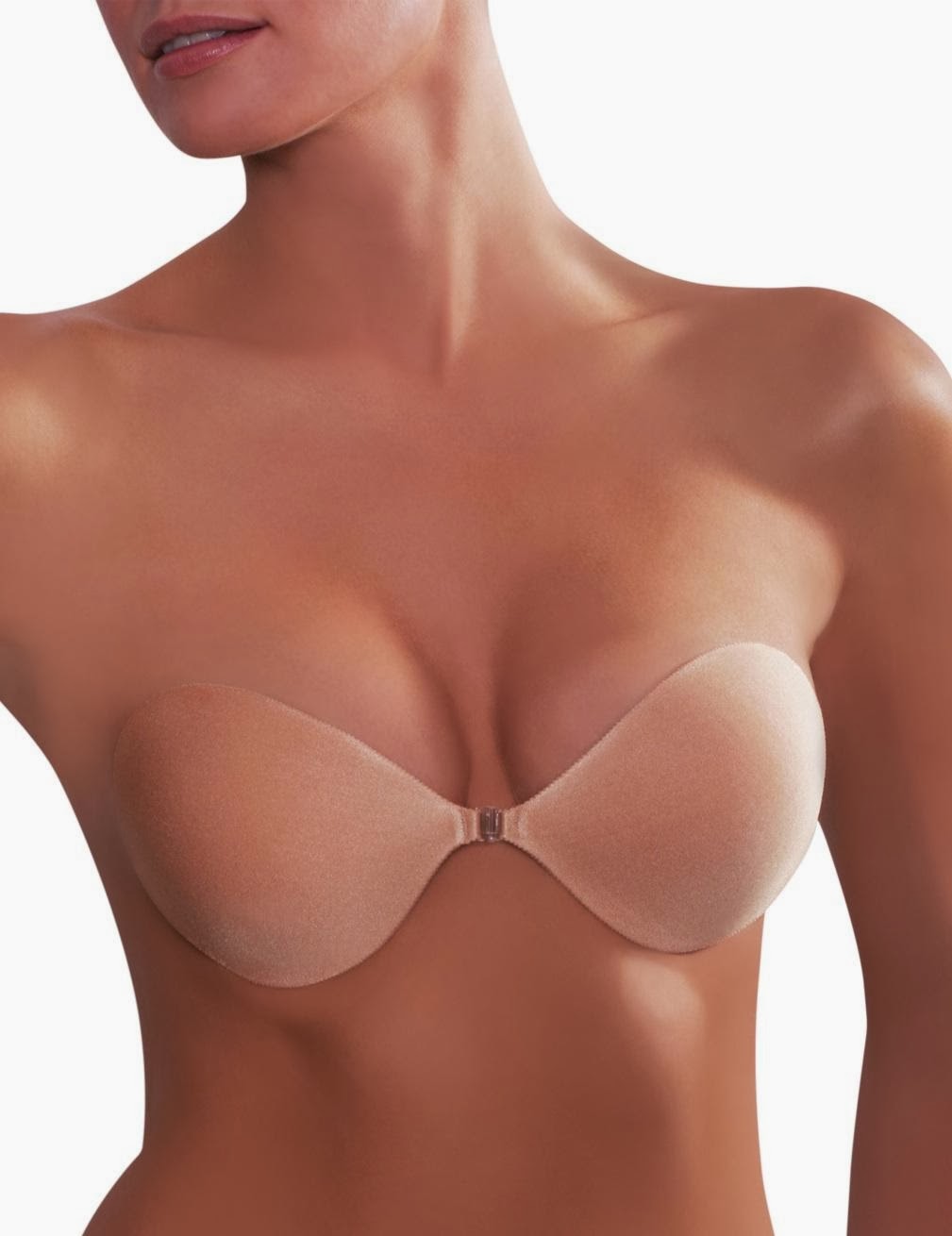
An adhesive bra is comprised of bra cups with medical grade adhesive on one side, which allow for the bra to be worn several times. They provide little support, however, they help fill out the bust and conceal the nipples under light fabrics. Adhesive bras have no straps or bands of any sort, this makes them ideal for backless and strapless fashions. They come in two types, disposable paper ones that use a strong adhesive and silicone ones that can be washed and reused. 
Backless Bra. 
Backless Bra: 
The backless bra has no back and is usually lightweight, self adhesive and self supporting. It's ideal for wearing under backless tops and dresses and of-the-shoulder numbers and the colours of the self adhesive types are often neutral or flesh colour, making them ideal to wear under sheer and low-cut clothing. 
Balconette Bra. 
Balconette Bras: 
Balconette bras are a more risque version of a demi bra with less coverage and more lift. They are a good choice for low neckline tops and dresses. Although they offer lift like a push up bra they do no push the breasts together in the center and have quite wide set bra straps. Balconette Bras can be worn under most clothing and suit a wide range of breast sizes. 
Bandeau Bra. 
Bandeau Bra: 
A bandeau bra is a simple band of cloth worn across the breasts, providing little support or shaping. 
Bridal Bra/Corset. 
Bridal Bra/Corset Bra: 
As the name itself suggest, the bridal bra or the corset is mainly used for marriages which helips in providing the desired shape for wedding dress. The main advantage of this type is that, it helps in giving the bride a good posture and can be more comfortable as the weight of the breasts is carried by the whole corset rather than the brassiere’s shoulder straps. 
Built-in Bra. 
Built-in Bra: 
Supportive brassiere-like structures on the inside of another garment, such as a swimsuit or tank top, which provide support for the bust without the need for a separate bra. In most such garments, these built-ins consist of a horizontal elastic strip, although some do have cups and underwires as with other bra types. In some cases these may easily be removed, if desired. 
Convertible Bra. 
Convertible Bra: 
It has straps which may be detached and rearranged in different ways depending on the outfit. Alternatives to regular straps for strapless bras are beaded bra straps or clear plastic bra straps that provide support and style. 
Demi Bra. 
Demi Bra: 
One of the most popular of the many different types of bra is the demi bra. A Demi Bra is a half-cup bra style with wide set straps and a horizontal bust line. Usually boned or seamed, they give great cleavage. Offering less support, but allowing low cut garments to be worn without the bra being seen as well as providing lift. Demi cup bras provide less breast coverage, generally cut to 1″ above the nipple. Most push-up bras are demi cups to show more cleavage. Most demi cups are designed to slightly push the breasts towards the center for more cleavage and remove breast tissue from under the arms. Demi bras are great for petite women who have issues with poking under-wires. 
Front Closure Bra. 
Front Closure Bra: 
Front closure bra have the closure, hooks and eyes in the front. The back of these bra type is very plain and also used in tank tops. 
Front-fastening Bra. 
Front Fastening Bra: 
Some people say that front fastening bras are more convenient than back fastenings as the clasps are easier to reach and the problem of fumbling with hooks behind your back is removed. Some men might say that front fastening bras are easier to deal with too. These bras can be wired or non-wired and come in a variation of styles and colours. They can be worn under any type of clothing including day wear and evening wear. 
Full-Cup Bra. 
Full Cup Bra: 
Full cup bras are designed to offer good support for the whole of the breast and are a practical bra for everyday wear. Covering the entire breast makes the bra look larger than it is. The full cup is designed to give more support for the breasts, this is very important for keeping the shape and fullness of the breast. Full cup bras can be very stylish and sexy, depending on the fabric that they are made of. Ideal for larger breasts and pregnant women as less support can lead to slight breast sagging and back pains. 
Full-Support Bra. 
Full Support Bra: 
Full Support Bra is the type of bra which is being used in the day to day life by most of the women. The Full Support Bra covers the whole of the breasts. 
Half-cup Bra. 
Half Cup Bra: 
Lingerie manufacturers do not always agree on what makes a half cup bra but as a general rule, it’s one where the cup stops just above the nipple. It is generally more suitable for a smaller cup but larger cup brands are becoming increasingly skilled at creating supportive bras that give a good impression of a half cup. 
Halter-neck Bra. 
Halter Neck Bra: 
These bras have clasps on the straps, which attach at the back of the neck and also around the back. They cover about 75% of the breasts and are suitable to wear under many types of clothes including strapless tops, dresses and off the shoulder numbers. 
Mastectomy Bra. 
Mastectomy Bra: 
Mastectomy Bra is a type of bra which is specially made for women who suffer from prosthesis. This type is also used by women who have lost one or both their breasts in breast cancer. 
Maternity Bra. 
Maternity Bra: 
Designed such that they can be expanded to adjust as the breasts increase in size over the course of a pregnancy. 
Minimizer Bra. 
Minimizer Bra: 
Minimizer Bras are designed to play down the bust, particulary for cup sizes 34C and above. They work by compressing and shaping the breasts, helping to create the illusion of being a cup size or two smaller, the minimizer also helps to prevent ‘spill over’ and should also help to give a more flattering, smoother look to the bust. These bras can be worn with day and evening wear and can give a smoother look to the bust area under clothing. The minimizer can also give extra support for larger sizes. 
Moulded Bra. 
Moulded Bra: 
So called because the cup is moulded from a single piece of foam or fabric so that it’s seamless. 
Multiway Bra. 
Multi way Bra: 
Multi-way bras have straps that can be worn in a variety of ways, such as over the shoulder, as normal, as a halterneck, crossed around the middle of the body or even removed altogether. It's extremely versatile and can be worn under all types and styles of clothing including low back, strapless and off the shoulder numbers. The multi-way bra can also be worn as any standard bra with t-shirts and dresses. One of the best things about the multi way bra is that the shoulder straps can be completely removed, making is ideal for dinner dresses and outfits for special occasions. 
Novelty Bra. 
Novelty Bra: 
Designed more for show and sensuality than for function. They may include unusual materials, such as leather, coconuts or be unusual in design. 
Nursing Bra. 
Nursing Bra: 
Nursing bras are made to make breastfeeding easier by giving the baby easy access to the nipple. Usually nursing bras have cups made of flaps of fabric that can be unhooked at the top and pulled down to expose the nipple. There are other designs out there involving holes built into the cup or zips and hooks for exposing the breast from the front but these are much less common. 
Padded Bra. 
Padded Bra: 
Padded bras have padding inside the lining. They are designed for small breasts to provide a fuller shape. Unlike push-up bras most padded bras support the breasts but do not significantly lift them. Padded bras do do vary slightly, some have more padding than others. They can offer anything from a slight lift to a more push up effect. All are very fashionable and feminine. Some padded bras may have removable inserts while others are just padded more on the lower part to give more lift and to help give the effect of more cleavage. Padded bras come in many sizes, colours and materials. 
Peephole Bra. 
Peephole Bras: 
The type of bra that has cups loosely covering the breasts, which also includes holes around the nipples. 
Plunge Bra. 
Plunge Bras: 
Plunge bras are distinguished by the part of the band that joins the cups. If it is below nipple level, then it's a plunge bra. These bras are ideal for wearing under low-cut tops and many plunge bras are padded to push your breasts together to maximize cleavage. 
Push-up Bra. 
Push-up Bra: 
Push up bras are structured in a way that lifts the breasts and pushes them closer together, enhancing the cleavage. The Wonderbra is a very well known brand of push up bra but there are many others. The padding in the bras are mostly either foam, gel or rubber. This padding is different from padded bras in its positioning, padded bras is centered under the breast and merely lifts them while push up bras have the padding at the side to push the breasts up and inwards. Its this padding positioning which gives push up bras such full cleavage. 
Racerback Bra. 
Racerback Bra: 
Has shoulder straps that come over the shoulder in a V pattern very close to the neck. This design is sometimes worn under strapless dresses or tops where traditional straps would be very obviously exposed. Many Sport bras use the racerback. 
Shelf Bra. 
Shelf Bra: 
Essentially a rigid band, usually underwires, along the infra mammary line that pushes up while covering none, or only a narrow strip, of the breast. 
Sport Bra. 
Sports Bra: 
Sports bras provide firm support for the breasts to prevent discomfort or embarrassment during exercise. Usually made of stretchable material they provide a snug fit. Their main role is to keep the breasts in place while exercising to reduce damage done to the soft tissues of the chest. 
Strapless Bra. 
Strapless Bra: 
Designed for wearing with clothes which reveal the shoulders. A very technically challenging designs they rely completely on the strength on the material around the bust, the designs of the under-wire and the width and tightness of the band. The most reliable strapless bras have a wide band around the back, boning under the arms, deep under-wires at the front, silicone strips along the inside to reduce slippage. Some larger size strapless bras also put boning in the cups for more support. Different from other under-wires strapless under-wires are taller and curve in to encompass the breast more. Even with all this sophisticated design strapless bras are still a little uncomfortable and can slip down during an active day or evening. 
T-shirt Bra. 
T-shirt Bra: 
T-Shirt Bras are made without any raised seams or decoration, this is to allow the bras to be worm with tight shirts without the bra being obviously visible. The cups are usually padded to hit the nipples from view and to give the bust a smoother look. The T-Shirt bra is not only for t-shirts and can be worn with any thin top where you want to have the bra less visible. Because of this they can also be known as seamless bras. 
Trainer Bra. 
Trainer Bra: 
Designed for young girls who have begun to develop breasts but have yet to be considered ‘developed’ enough to allow for a standard-sized bra to fit properly. They are of simple construction and offer very little support. 
U-plunge Bra. 
U-plunge Bra: 
Allows you to wear clothes that have a deep plunging neckline. 
Vintage Bra. 
Vintage Bra: 
A type of full support bra with cups in the shape of a paraboloid of revolution with its axis perpendicular to the breast. Invented in the late 1940s, they were still being sold well into the 1960s. 
Water Bra. 
Water Bra: 
Bras which have water or silicon gel-filled cups to make your breasts looks larger.